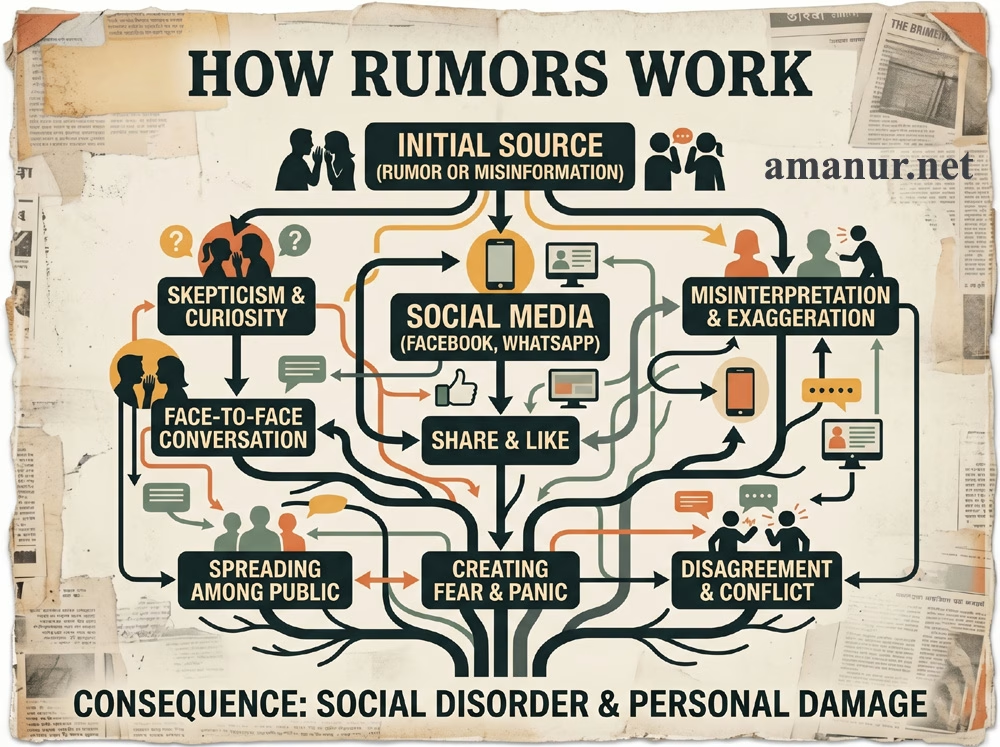

Recently, rumors have emerged as another name for terror in Bangladesh. Particularly surrounding the Durga Puja festival of the Hindu community, numerous such rumors are spreading across the country, creating a communal poisonous atmosphere. Meanwhile, the administration is taking a strict stance to thwart these malicious attempts to create communal conflicts by spreading rumors.
“FactWatch,” a Facebook-approved fact-checking organization in Bangladesh, states that over the past week, multiple fake posts and videos have been circulated to incite communalism. Information on quite a few of these fact-checks was found on the verified Facebook page of the administration. Among them, one notable rumor was titled “Hindus entered a mosque in Comilla, tore the Holy Quran, and defecated.”*
This headline’s news and accompanying photo went viral on Facebook. However, FactWatch’s investigation revealed that this was actually an incident from the year 2016. Back then, a mentally unstable individual entered a mosque and caused this incident. His name was Jahangir, and he was not a member of the Hindu community. For obvious reasons, FactWatch has determined this to be “False.”
Another rumor headline was “Mizanur Rahman Azhari gives a stern warning over the desecration of the Quran.” This 2-minute-46-second video went viral, and due to the manner of its presentation, many were misled into thinking that Mizanur Rahman Azhari might have given a speech in light of the recent incidents in Comilla. However, FactWatch’s investigation shows that this video was created by splicing together two different pieces of video footage.
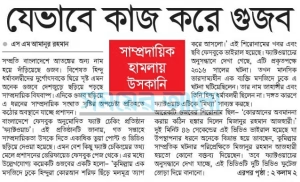
(How Rumors Work: Continued on Page: 2, Column 2)
In that old video edit, Mizanur Rahman Azhari was seen saying, “The Holy Quran has been desecrated by entering a mosque in Comilla—the fire of protest must be lit in every home.” A completely fake piece of information was spread through Facebook using an old video. In the context of the recent incident in Comilla, it is now falsely claimed that he has been arrested for protesting the Quran desecration. However, according to FactWatch’s investigation, “The accused has been arrested regarding the Comilla incident, but the video belongs to a completely different incident where an individual was arrested in Chittagong.”
Similarly, another organization discovered a fake post with an online headline that read: *”30 arrested, 52 Awami League members over the desecration of the Quran in Comilla.”* Although it claimed 52 Awami League workers were among those arrested, no such names or statistics were provided in the main text, nor has any such three-way classification been provided by the media or the police.
Several more such fake posts have been found: *”Grandson of Ratan and Pratima murdered in Trilokpur Hindu Youth Grand Alliance co-organizer Manik Sahar’s house.” “Durga Mandir was vandalized in 2017, and a temple was set on fire in Hajiganj.” * In 2021, rumors spread: “32 dead, 109 missing! 10 innocent Sanatan children and 5 children were killed on August 10.”* Such false and fabricated posts have been proven false through scientific research by FactWatch laboratories.
Furthermore, a person named Saikat Mandal posted on Facebook regarding an incident in Pirganj, stating, *”A dead body was recovered from the village pond; a Muslim was beaten and killed by a Hindu mob.”* Regarding this post, the individual wrote, “Protest rallies were held under the banner of ordinary people protesting the insult to the Holy Quran by Karimpur Manikpara area residents in No. 15 Karimpur Union under Pirganj upazila.’ However, that text was completely false and fabricated, and because of this post, attacks were carried out on the houses of the Tanti community, resulting in properties being set on fire.
Another fake incident was spread using an old video clip showing a man being beaten, claiming a Hindu named Ratan Gaya was beaten to death. However, ICT specialists identified the man as a person who was beaten to death in Mirpur. In connection with this incident, law enforcement arrested Ruba, an assistant professor at Begum Rokeya Government Mohila College, on charges of spreading false and fabricated videos on social media under the Digital Security Act.
Regarding such rumor-spreading processes, FactWatch worker Swapan Das says, “We do this, we investigate the information behind these incidents to see if what is circulating in our name is true or false, and then we alert everyone through reports.” Our team works very fast on these issues using specific toolkits. Based on the ICT analysis, tech workers are alerted via Facebook that notes are broken, false, or fabricated.
However, if someone wants to check whether these rumor-spreading incidents are minor, serious, or unknown, he said, “If the message contains a text/photo or a video that is completely unverified, those who practice fact-checking can cross-verify and see. Devotees also do not fall behind in assessing these. It spreads among the general public at a massive rate. Individually, it must be taken to a personal level.”
“We have seen several examples of this happening in recent times. But who is spreading these rumors?
In this context, if we look at it through Dhaka University’s Criminology and Criminal Justice Department Professor Dr. Zia Rahman, we see rumors being spread at three levels: ground level, middle level, and top level. At the ground level, a local person is picked up to cook up a small story. At the middle level, that packet story is distributed to a larger group to execute a minor or major conflict. We see the utilization of terrorist networks to turn a tiny issue into an international crisis. In reality, both are the same. At the top level, it is explicitly organized; these are politically motivated. Discussion takes place following a North Korean-style rule. We do not know the actual masterminds behind it. But from a structural perspective, such a story is created and handed over to us. This is also being done in our country. However, it progresses through a highly calculated structural pipeline. Identifying it globally is not entirely impossible. But we are not completely safe. Not even in our security.”
To learn about these rumor processes, the General Secretary of the Bangladesh Hindu Buddhist Christian Unity Council, Advocate Rana Dasgupta, says, “We have been seeing this from the very beginning; these cases are being conducted in the same manner. In these incidents, the police are arresting people under the Digital Security Act every single time. But who is actually operating this master plan? That remains beyond our grasp. Our weakest point lies exactly there. ‘Then why are these incidents taking place?’—this is a political matter. Political leaders must act responsibly to protect innocent people. If that doesn’t happen, these communal incidents will be used as a political vote bank. Moving away from calculations based on political gains is the only way this mindset can change. If we cannot build a secular state for all, then separating specific target groups will prevent a truly democratic Bangladesh from being formed.”
Former Vice-Chancellor of Dhaka University and Communication Expert Professor Dr. AAMS Arefin Siddique stated, “Information technology is a powerful force; this force must be applied to public welfare. Using this force for criminal activities by presenting false info is a punishable offense. To curb these crimes, the Digital Security Act was enacted. If we can penalize the real culprits behind creating these IT rumors by identifying them through this law, then creating such rumors will naturally decrease.”
Shovon, a young software trainee, shared his thoughts on using information technology to resist rumors. He said, “In this case, primary training must be provided from the school level, and ethical and moral education regarding tech usage must be taught. Suddenly, we gained access to power (the use of tech), but we didn’t learn the rules of using it; as a result, we are spreading it however we want, just like a person killing a patient with a surgical blade in his hand. If you hand a surgical blade to an uninitiated person, he will kill a healthy human being. There is no doubt about it. The same thing is happening here.”
ICT specialist Tanvir Hasan Zoha stated that the capability to prevent rumors must be increased at the source. Until you take control, these incidents will continue to occur. In this case, three main steps must be taken. This is a primary natural process. In this regard, a highly specialized lab must be set up for the 64 districts of the country. This is because standard cyber units take a lot of time, allowing criminals to flee. Administrative lethargy on these issues must be strictly controlled. Secondly, legal discipline: every official must be given a specific deadline, within which they must submit their investigation report. This will reduce the long stagnation of cases. Third is diplomatic policy: platforms like Facebook have their own regulations under the jurisdiction of regional authorities. If India can form a panel with Facebook, why can’t we? We are lagging behind them in many perspectives. Therefore, an administrative panel should be formed to track down who is making fake trial posts, from where, and how. Otherwise, these criminal trends cannot be suppressed.
RAB’s Additional Director General (Operations) Colonel KM Azad stated, “Administrative measures are underway. Many of those who are creating and spreading rumors have already been arrested. Over the past 24 hours, many more have been added to our arrest list based on our monitoring.”
Regarding the concern that these rumors could create unrest and a volatile situation across the country, he said, “The incident of arson in Rangpur (Pirganj)—that was a rumor. We observed a video of a minor clash being portrayed as a massive riot. In the case of the Mirpur domestic worker murder rumor, false casualties were broadcast to spread panic. Continuous administrative surveillance is being maintained over these issues.”
RAB’s Additional Director General added, “Management of rumor incidents is in place. Otherwise, how could we control them? Those who took the law into their own hands have been arrested.”
Discussing how to counter rumors, a meeting was held at the Ministry of Home Affairs. The Home Minister stated, “We have identified those who masterminded the incident in Comilla’s Puja Mandap. He is repeatedly changing his location. We will be able to capture him very soon. We can confirm how he orchestrated this incident in Comilla once he is caught.”
Currently, the country’s cybersecurity investigation unit is operational. Every day, approximately 3 to 4 cases of cybercrime are received. However, the number of accusations is not small. The Cyber Unit stated that in the case of such crimes, fast tracking and swift reporting are crucial to saving lives. Without expanding local and forensic lab networks, administrative monitoring under this law will become obsolete. Particularly because all rumors spread via social media, the cybersecurity unit lacks the capacity to monitor all platforms simultaneously due to insufficient active integration initiatives.
Nevertheless, IT experts believe that strictly monitoring the digital landscape and taking timely administrative action against those spreading communal incitement via social media is essential. To this end, the capabilities and scope of cybersecurity units must be further expanded. In their view, strict enforcement of the law against elements trying to instigate nationwide instability is imperative.
S M Amanur Rahman
Freelance Journalist
(Note: The news was first published on 22nd October, 2021, in Daily Somoyer Alo: Click the link)